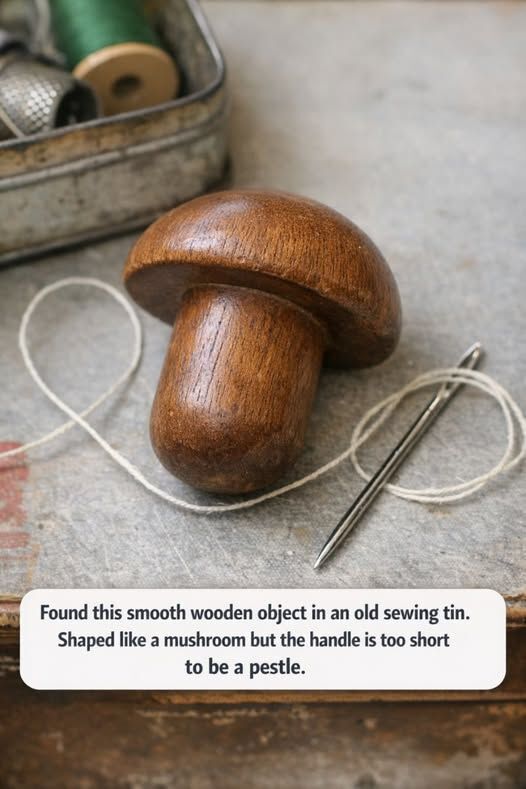
Every detail of the tool serves a purpose:
-
Smooth, rounded cap: Prevents snagging while allowing the fabric to stretch evenly in all directions.
-
Durable hardwood: Often crafted from beech or maple, chosen for strength and the ability to stay smooth over decades of use.
-
Occasional decorative accents: Some were left plain and simple. Others feature painted tops or carved handles—small touches of beauty on an everyday tool, proof that even the most practical objects could be made with care.
What Sewing Tins Tell Us
Opening a vintage sewing tin is like opening a time capsule. Each object inside tells a story about the person who owned it, the life they lived, the values they held. A darning mushroom suggests a household where thrift was a virtue, where nothing was thrown away before its time, where skills were passed down and tools were cherished. These weren't just objects—they were companions in the work of running a home.
Different Forms
While the mushroom shape is the most recognizable, similar tools exist in other forms. Darning eggs are oval-shaped versions that serve the same purpose, often favored for their symmetrical shape. Some were made of wood, others of porcelain or even glass. Some were purely functional, others decorated with flowers or patterns, reflecting both utility and artistry in equal measure.
Using One Today
If you're lucky enough to have found a darning mushroom—or if you pick one up at an antique shop or flea market—give it a try. You don't need to be an expert seamstress. Just:
-
Position a worn sock over the curved surface.
-
Stretch the fabric evenly, not too tight.
-
Use a needle and thread to stitch straight lines across the opening, then weave crosswise through them.
The result is a sturdy repair that extends the life of the garment. It's satisfying in a way that's hard to describe—the feeling of fixing something with your own hands, of pushing back against a world that tells you to throw things away.
Preserving a Vintage Tool
If you've inherited or acquired an old darning mushroom, a little care will keep it in good shape for years to come:
-
Wipe it gently with a damp cloth—never immerse it in water, which can crack or warp the wood.
-
Occasionally rub it with a small amount of mineral oil or beeswax to keep the wood conditioned and smooth.
-
Store it somewhere dry, away from extreme heat or cold.
A Piece of Domestic History
see continuation on the next page
Continue reading by clicking the ( NEXT 》 ) button below !