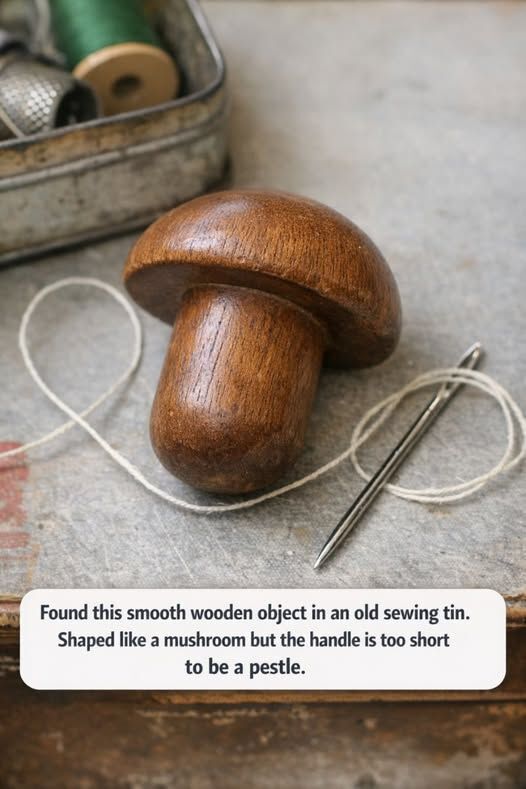
Discovering the Darning Mushroom: A Vintage Sewing Tool
If you've ever sorted through an old sewing box—the kind that gets passed down from grandmother to mother to daughter—you know how many unexpected treasures can appear. Tucked between spools of faded thread, scattered buttons, and a pincushion that's seen better days, you might come across a small wooden object shaped like a mushroom. Rounded top, short handle, smooth as silk from years of handling. And for a moment, you hold it in your palm and wonder: what on earth is this?
The Curious Wooden Shape
This smooth, palm-sized tool typically has a cap about three inches wide and a stubby handle roughly two inches long. Its polished surface hints at decades of use—fingers that held it, thread that passed over it, socks that stretched across it. Though it resembles something you'd find on a forest floor, its presence in a sewing kit tells you it belongs to a different world entirely: the world of fabric repair, of mending and making do, of stretching a wardrobe as far as it could go.
Definitely Not for the Kitchen
At first glance, some mistake it for a small pestle—the kind used with a mortar for grinding spices or herbs. But the design doesn't support that idea. A true pestle needs weight and leverage. This lightweight, rounded object was made for something far more delicate: careful, detailed work done by lamplight on quiet evenings.
Introducing the Darning Mushroom
The mystery item has a name, and once you know it, it makes perfect sense: it's a darning mushroom. A classic sewing aid used for generations to mend holes in socks and stockings. The curved top mimics the shape of a heel or a toe, providing the perfect surface for stitching torn fibers back together. In earlier generations—before fast fashion, before "just buy a new pair"—clothing was repaired repeatedly. Socks were darned, elbows were patched, and this simple wooden tool was a staple in nearly every household.
How It's Used
Using a darning mushroom is straightforward, almost intuitive:
-
Slip the damaged sock over the rounded top, positioning the hole right at the center of the curve.
-
Pull the fabric snug—not tight, just enough to create a smooth, even surface to work on.
-
Stitch back and forth across the gap, first in one direction, creating a series of parallel lines.
-
Then weave stitches across the other way, over and under, until the hole is filled with new thread that blends with the old.
This weaving technique—called darning—does more than just close a hole. It reinforces the entire area, creating a patch that's strong enough to withstand walking, yet flexible enough to move with the foot.
Thoughtful Construction
Continued on next page
Continue reading by clicking the ( NEXT 》 ) button below !