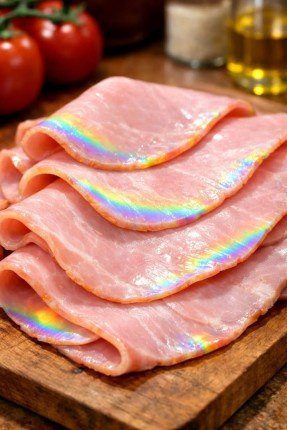
You open the refrigerator, pull out a package of deli ham, and notice something unexpected: a rainbow-like sheen glistening on the surface of the slices. It's a striking sight—colors shifting from green to gold to copper as the light hits the meat. But it can also be unsettling. Is this normal? Has the ham gone bad? And most importantly, is it safe to eat?
If you've ever found yourself staring at iridescent lunch meat, unsure whether to make a sandwich or head to the trash can, you're not alone. Here is everything you need to know about that rainbow shine, backed by science and expert guidance.
1. What That Rainbow Shine Actually Is
The colorful effect you're seeing is called iridescence. It is a physical phenomenon, not a sign of spoilage or contamination. Iridescence occurs when light waves interact with a surface structure that causes them to split and reflect at different angles, creating a spectrum of colors.
You've seen this effect before:
The shifting colors on a soap bubble
The rainbow patterns on the surface of a DVD or CD
The shimmer on an oil slick or a puddle
On deli ham, the iridescence is created by the meat's own structure. The precise arrangement of muscle fibers, combined with the thinness of the slice, can cause light to diffract—essentially breaking into its component colors—as it hits the surface.
2. The Science Behind Iridescent Meat
To understand why ham can look rainbow-colored, it helps to know a bit about how meat is structured.
Muscle tissue is made up of long, parallel fibers. When meat is sliced, especially when it is sliced very thinly for deli purposes, these fibers are cut in a way that creates a uniform, slightly ridged surface. This surface can act like a diffraction grating—a microscopic pattern that splits light into its separate wavelengths.
Several factors influence how pronounced the iridescence appears:
Thinness of the slice: Thinner slices create more uniform surfaces, enhancing the effect.
Grain of the meat: Slicing across or along the muscle fibers changes how light reflects.
Moisture content: The presence of water or fat on the surface can amplify the shimmer.
Lighting conditions: Bright or angled light makes the iridescence more visible.
This phenomenon is not unique to ham. It can also be observed on roast beef, turkey, corned beef, and other cured or cooked meats.
3. When a Rainbow Sheen Is Completely Normal
In the vast majority of cases, an iridescent sheen on deli ham is perfectly normal and safe. It is a natural optical effect, not a chemical reaction or a sign of bacterial growth.
You can confidently eat the ham if:
It has been stored properly in the refrigerator.
It is within its expiration date.
It smells fresh and mild.
It feels dry or slightly moist, but not sticky or slimy.
The only unusual feature is the rainbow shine.
Many butchers and food scientists consider iridescence to be a marker of high-quality meat that has been sliced cleanly and thinly, allowing its natural structure to be visible.
4. Visual Red Flags That Signal Spoilage
see continuation on the next page
Continue reading by clicking the ( NEXT 》 ) button below !